

Emergence And Applications Of Three-Dimensional Integrated Optical Fiber Devices
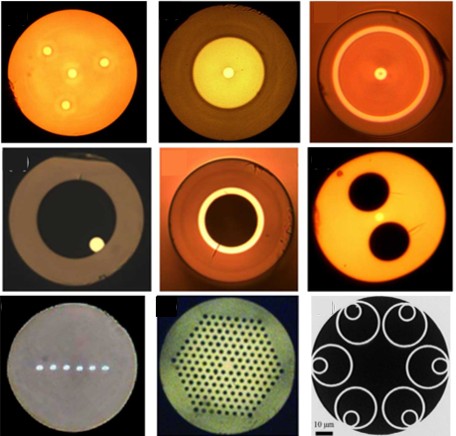
Figure 1: Cross sections of optical fibers with different two-dimensional structures
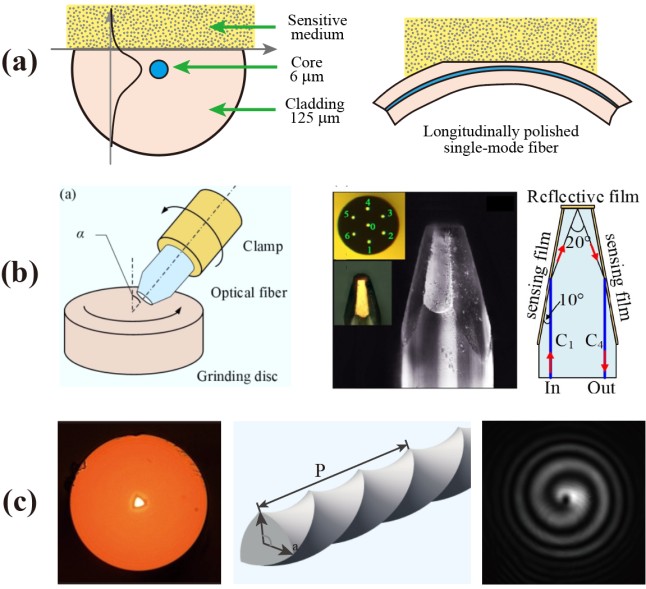
Figure 2: Three-dimensional integration methods for several typical fiber structures: (a) Fiber-side-ground biosensor; (b) Fiber-end-polished technology and reflective SPR sensor; (c) Fiber helical twist and its generated vortex field.
It outlines the fundamental concepts and methodologies involved in creating such fiber-based integrated systems.
CHINA, December 5, 2025 /EINPresswire.com/ -- With the rapid advancement of the information age, the demand for data transmission and processing has surged dramatically. As an efficient carrier for optical communication and data transmission, fiber optic technology is facing unprecedented challenges and opportunities. While traditional two-dimensional fiber-integrated devices dominate optical communication systems, they still face significant bottlenecks in achieving higher integration, more complex functionality, and smaller device sizes. Particularly in applications requiring complex signal sensing and multidimensional data transmission, single two-dimensional structures can no longer meet the demands of modern fiber systems. Therefore, exploring three-dimensional integrated fiber device technology has become a crucial direction for advancing fiber technology.In recent years, researchers worldwide have focused on developing three-dimensional integrated optical device systems, with optical fibers as the foundational platform. This approach miniaturizes complex optical paths and components within a single fiber. By integrating these elements or systems into a single fiber from a novel physical perspective, this technology creates diverse, feature-rich "fiber laboratories." These fiber-based three-dimensional integrated photonic devices not only hold broad application prospects in optical communications but also possess significant value in fields such as medicine and sensing. With continuous technological advancement, it is anticipated that more innovative fiber devices will emerge in the future, bringing new transformations to various industries.
Recently, Professor Libo Yuan's team from Guilin University of Electronic Technology has invited to contribute a review article entitled "Three-dimensional integrated optical fiber devices: emergence and applications" for the second issue of Opto-Electronic Technology in 2025. This review systematically summarizes methods for integrating three-dimensional photonic devices onto optical fibers using refractive index-guided special microstructure waveguide fibers. It delves into the functional characteristics of these technologies and their significant value in optical communications, distributed sensing, scientific research, and medical applications, while also outlining their future application potential.
The paper first reviews the concept and historical development of three-dimensional integration in fiber devices. Starting from the quasi-one-dimensional ideal fiber concept, it explains how two-dimensional cross-sectional structures expand fiber functionality. Subsequently, using fiber gratings as an example, it highlights the significance of fiber devices with three-dimensional refractive index variations. In the third section, the author summarizes approaches for designing end-face structures to enhance fiber functionality, discussing the diverse capabilities and critical applications of microstructured fibers such as multi-core fibers with distributed cross-sections, core-hole integration, photonic bandgap fibers, and anti-resonant fibers.
Next, the author highlights multiple approaches for achieving three-dimensional integration within optical fibers. Side polishing of fiber surfaces enables interactions between diverse materials and evanescent fields, establishing a foundational platform for numerous biosensors. Geometric polishing of fiber end-faces provides a versatile and precise method for end-face beam control, enabling beam shaping and directional propagation control to construct optical potential wells and interventional OCT probes. Post-welding etching of heterogeneous fibers can transform specific cross-sectional regions into complex three-dimensional microstructured optical devices, including micro-resonators and highly sensitive sensors. Controlled tapering and twisting of fibers induce mode coupling, enabling devices like long-period fiber gratings and vortex beam generators. Fiber thermal diffusion technique can reconstruct a three-dimensional refractive index profile inside the fiber, achieving low-loss coupling between different waveguide components. Furthermore, assembling microstructured devices within fibers facilitates the easy realization of high-efficiency micro-resonators and sensing functional devices. Additionally, this paper introduces microfabrication techniques and new composite fiber materials for enhancing fiber device performance, along with methods for integrating various materials with fiber devices.
In summary, these methods for realizing three-dimensional fiber structures reflect the trend toward highly integrated, multifunctional, and microsystem fiber devices. Building upon the inherent properties of optical fibers and supported by diverse fabrication techniques, multiple three-dimensional devices have been successfully integrated. Such devices may achieve further breakthroughs in areas such as miniaturization of optical components, integrated communication and sensing, optoelectronic hybrid chip integration, and minimally invasive fiber-optic medical interventions. Looking ahead, the evolution of fiber optic technology will resemble biological evolution—advancing from simple one-dimensional structures to more complex three-dimensional configurations. It will continuously integrate diverse functions to meet personalized demands, demonstrating the boundless potential for constructing "fiber optic laboratories" and their clinical value and developmental prospects in minimally invasive interventional surgery.
This work was supported by the National Natural Science Foundation of China (U23A20373, 62305231).
About the research group:
Libo Yuan is a Specially Appointed Distinguished Professor, Doctoral Advisor, and Director of the Photonics Research Center at Guilin University of Electronic Technology. He has been honored with the Guangxi Bagui Scholar award. He received his PhD from The Hong Kong Polytechnic University in 2003. He has led projects including the National Key R&D Program, the National Major Scientific Instruments and Equipment Development Project, the National Major Research Instruments Development Project, key projects and major projects (topics) of the National Natural Science Foundation of China. He has published over 300 SCI-indexed academic papers with more than 3,000 citations. He holds over 150 authorized national invention patents and 23 internationally authorized patents. He has authored four academic monographs.
Tingting Yuan is an Assistant Professor at the School of Future Technology, Shenzhen Technology University. Her research focuses on fiber-integrated sensing technology and the design and fabrication of optical fiber sensors. She has published over 30 academic papers and filed more than 30 patent applications, including 8 authorized Chinese invention patents and 11 Australian patents as the primary inventor. She has led the National Natural Science Foundation of China Young Scientist Program and the Pengcheng Peacock Newly Introduced High-End Talent Financial Subsidy Research Start-up Project, and participated in national key projects and general projects.
Read the full article here: https://www.oejournal.org/oet/article/doi/10.29026/oet.2025.250007
Andrew Smith
Charlesworth Publishing Limited
+44 7753 374162
marketing@charlesworth-group.com
Visit us on social media:
LinkedIn
YouTube
Other
Legal Disclaimer:
EIN Presswire provides this news content "as is" without warranty of any kind. We do not accept any responsibility or liability for the accuracy, content, images, videos, licenses, completeness, legality, or reliability of the information contained in this article. If you have any complaints or copyright issues related to this article, kindly contact the author above.
