

New Scenarios for Photonic Computing: A New Era of Photonic AI for Medical Diagnosis
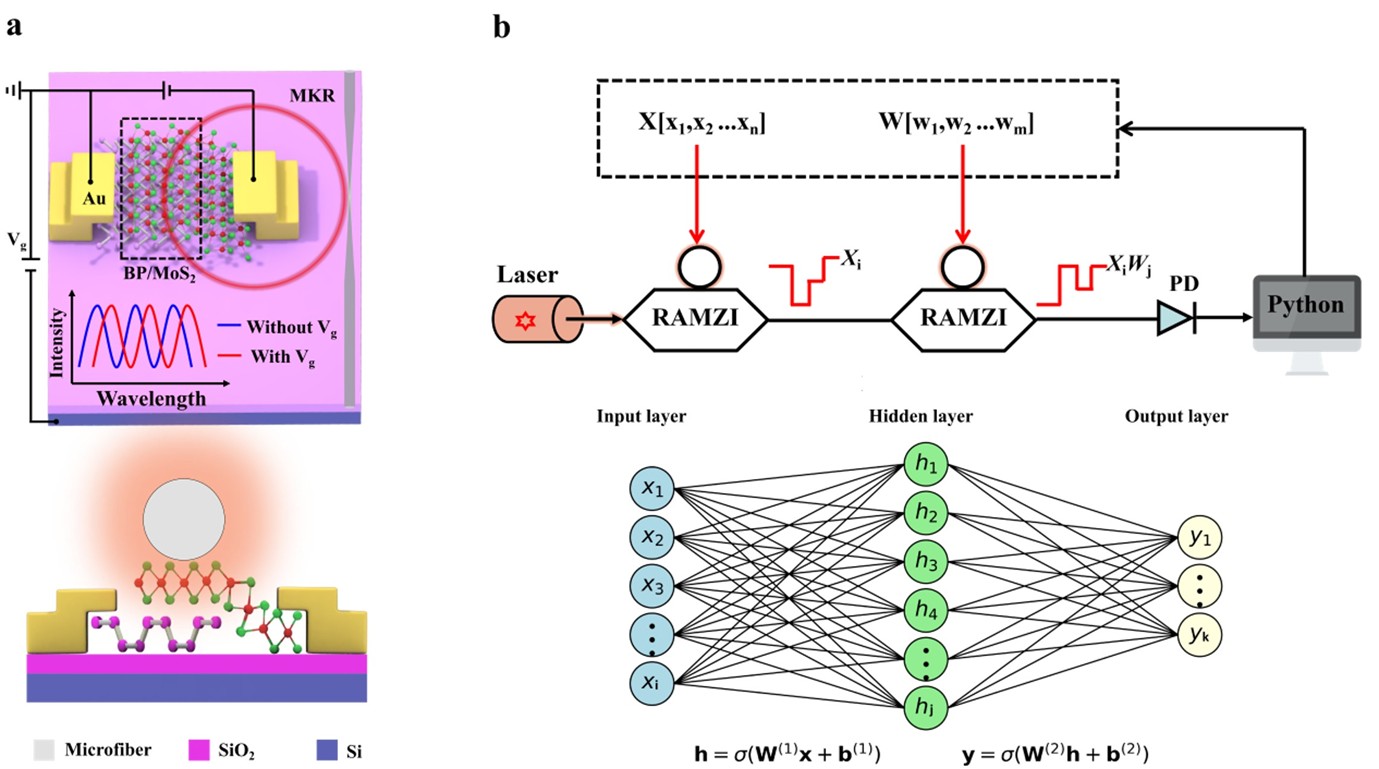
(a) Schematic of the electro-optic modulator based on a BP/MoS2 heterostructure integrated with a microfiber knot resonator. (b) Time-division multiplexing photonic computing architecture for all-fiber photonic neural network operation.
Replacing Electrons with Photons: A Green Revolution in AI-Powered Medical Diagnosis
CHENGDU, CHINA, June 17, 2026 /EINPresswire.com/ -- Shenzhen University researchers, with industry partners, developed a black phosphorus-based all-fiber photonic AI platform for medical diagnosis. Built around a microfiber knot resonator, a black phosphorus and molybdenum disulfide heterostructure, and a specialized architecture, the system enables low-power, high-speed optical computing. In clinical tests, it performed well in retinal detachment and liver cancer diagnosis, matching senior radiologists while greatly improving energy efficiency and latency. The work points toward scalable, sustainable photonic AI for healthcare applications.Recently, a major breakthrough was achieved by the research team led by Professor Han Zhang from the College of Physics and Optoelectronic Engineering at Shenzhen University, China, in collaboration with Shenzhen Metasensing Technology Co., Ltd. and Shenzhen All-Optical Era Technology Co., Ltd. The team developed a black phosphorus-based all-fiber photonic artificial intelligence (AI) diagnostic platform. The results were published online in Opto-Electronic Advances journal on May 28, 2026, under the title, “Tunable phosphorene modulators – accelerating medical diagnosis with ultra-efficient photonic platforms,” marking a green revolution in AI medical diagnosis by “replacing electrons with photons.”
The co-first authors are Dr. Yi Liu, Huide Wang, and Honghai Zhu, and the corresponding author is Prof. Han Zhang. Shenzhen University is the primary affiliation, with Shenzhen Metasensing Technology Co., Ltd. and Shenzhen All-Optical Era Technology Co., Ltd. as co-developers. This tripartite collaboration achieved a full-chain breakthrough from laboratory material innovation to engineered system integration.
Photon-based computing overcomes energy and speed bottlenecks in medical AI
AI is increasingly empowering medical imaging, efficiently assisting in the detection of cancers, retinopathies, and other diseases. However, current AI systems rely heavily on electronic processors such as GPUs, which consume large amounts of energy, generate excessive heat, and suffer from latency when processing massive medical image datasets. These limitations restrict real-time diagnostic applications and contribute significantly to carbon emissions.
Photonic computing offers a disruptive solution by using light as the computational medium. Light travels at extremely high speed, different wavelengths can carry data in parallel, and it generates almost no heat. Nevertheless, practical adoption has long been hindered by the low efficiency, large size, and complex fabrication of conventional optical modulators, which are the key devices for controlling optical signals at high speed and low power.
In this joint industry–academia effort, the team chose two atomically thin two-dimensional materials, black phosphorus (BP) and molybdenum disulfide (MoS2), to construct a van der Waals heterostructure. This heterostructure was then integrated onto a microfiber knot resonator (MKR), a micron-scale loop made of an optical fiber thinner than a human hair. The MKR dramatically enhances light-matter interaction, requiring only a tiny voltage to change the material’s refractive index and shift the light wavelength, thereby achieving highly efficient optical modulation.
The research team started by fabricating high-quality BP/MoS2 heterostructures using mechanical exfoliation and dry transfer. They then integrated the heterostructure onto a MKR, hundreds of micrometers in diameter and waist-tapered to a few micrometers, to strengthen evanescent field coupling. To improve linearity, they introduced a Ring-Assisted Mach–Zehnder Interferometer (RAMZI) structure, which extends the linear operating range and reduces nonlinear distortion. Finally, using two RAMZIs and a photoreceiver in a time-division multiplexing architecture, they built a complete all-fiber photonic neural network (PNN), achieving a closed-loop development from core devices to a full system.
Clinical validation: diagnostic accuracy on par with senior radiologists, with 246-fold energy efficiency gains
Prof. Zhang said, “This PNN is ideally suited for real-time medical image diagnosis, especially in time-critical clinical settings.” In collaboration with the team of Prof. Wei Chi at Shenzhen Eye Hospital and Prof. Liping Liu at Shenzhen People’s Hospital, the researchers validated the system on two representative tasks: retinal detachment detection from B-scan ultrasound images and hepatocellular carcinoma (HCC) diagnosis from multiphase liver computed tomography (CT) scans.
In the retinal task, the team used 40 desensitized B-scan images of retinal detachment and 40 images of normal retinas. In the HCC task, using a dataset of 3,348 dynamic contrast-enhanced CT studies, including 2,458 biopsy-confirmed HCC cases and 890 normal controls, the system achieved 95.0% accuracy and 97.6% specificity—performance comparable to experienced radiologists.
Key performance comparisons
• Processing one liver CT study takes 85 ms on an NVIDIA A100 GPU, but only 0.8 ms on this photonic system.
• Energy per operation is 0.608 fJ for the photonic system, compared with 150 fJ for the NVIDIA A100 GPU, corresponding to a 246-fold improvement in energy efficiency.
This means that expert-level AI diagnostic capabilities could be deployed to rural clinics, ambulances, and resource-limited areas, greatly improving healthcare accessibility. For early-stage liver cancer smaller than 1 cm, where 5-year survival exceeds 70%, ultra-fast diagnosis could translate into more lives saved. Moreover, photonic computing dramatically reduces the carbon footprint of AI computing, offering a viable path toward green AI and sustainable healthcare.
Limitations and future outlook: industry–academia collaboration to drive commercialization
The team notes that the current system still has room for improvement. It currently uses only two modulators to implement a single layer, so processing higher-resolution and more complex medical images will require scaling up. Leveraging the advantages of industry–academia collaboration, future efforts will focus on wavelength-division multiplexing (WDM). By utilizing the device’s approximately 30 nm modulation bandwidth and dense resonance comb, a 40-channel WDM system could increase computational density by about 40 times without increasing the clock speed, enabling about 4,000 multiplications per layer.
For long-term stability, while the MoS2 capping layer provides short-term protection, the team plans to work with industry partners to implement industrial-scale encapsulation, such as atomic layer deposition of Al2O3, and large-area chemical vapor deposition growth. These steps could further improve device stability and manufacturing consistency and accelerate the transition from laboratory research to clinical use.
“This work demonstrates that fiber-based PNNs are not just laboratory concepts but practical diagnostic platforms,” Prof. Zhang notes. The combination of ultra-low transmission loss, below 0.2 dB/km in optical fibers, high-modulation efficiency of 0.25 V·cm in the RAMZI device, and excellent linearity overcomes core bottlenecks in previous photonic computing efforts. It heralds a new era in which optical AI processors may empower medical imaging, drug discovery, and genomic analysis with far lower energy consumption than electronic devices.
Reference
Title: Tunable phosphorene modulators – accelerating medical diagnosis with ultra-efficient photonic platforms
Journal Name: Opto-Electronic Advances
DOI: https://doi.org/10.29026/oea.2026.250332
About Professor Han Zhang from Shenzhen University, China
Han Zhang is a Distinguished Professor at Shenzhen University, Optica Fellow, and was among the first recipients of the National Science Fund for Excellent Young Scholars and the Youth Thousand Talents Program. He has led key projects of the National Natural Science Foundation of China and the National Key Research and Development Program. His research focuses on ultrafast lasers and novel optoelectronic devices. He has over 100,000 citations (H-index 180). As the lead recipient, he won the First Prize of Natural Science of Guangdong Province, and as a co-recipient, he won the First Prize of Technological Invention of Guangxi (ranked 2). He has also received the Guangdong Province Ding Ying Science and Technology Award and the Guangdong Youth Science and Technology Award. His team currently consists of more than 20 researchers, including postdoctoral fellows, PhD candidates, and master’s students, collaborating closely with physics, materials science, and biomedicine. Core achievements include ultrafast photonic logic processing units and ultrafast photonic biosensors. The group has published extensively in high-impact journals such as Nature Photonics, Nature Communications, and PNAS.
Funding information
This work was supported by Guangdong Province Major Project of Fundamental and Applied Fundamental Research (2025B0303000020), the National Natural Science Foundation of China (62405195, 62375185), Department of Science and Technology of Guangdong Province (2023B0101200003), Department of Education of Guangdong Province (2022ZDZX1023), Key Projects (B) of the Stability Support Program for Shenzhen Higher Education Institutions (20220810151419001), Shenzhen Science and Technology Program (KCXFZ20230731093359004, KJZD20240903102741053), Shenzhen's key industry R&D project (ZDCY20250901102031004), Research Team Cultivation Program of ShenZhen University, Grant No. 2023QNT008, The Hangzhou Normal University “Project to the summit” chemical discipline, the Ministry of Education Key Laboratory Open Scientific Projects Fund (KFJJ2023007), LingChuang Research Project of China National Nuclear Corporation (No. CNNC-LCKY-202268), “Tianchi Talent” Introduction Plan, and Shenzhen Science and Technology Program (ZDSYS20230626091501002).
Conor Lovett
Compuscript Ltd
c.lovett@cvia-journal.org
+353 61 475 205
Legal Disclaimer:
EIN Presswire provides this news content "as is" without warranty of any kind. We do not accept any responsibility or liability for the accuracy, content, images, videos, licenses, completeness, legality, or reliability of the information contained in this article. If you have any complaints or copyright issues related to this article, kindly contact the author above.
